Nuclear Mechano-Oncology lab
My main research focus is to study the architecture of cell’s largest organelle, the nucleus. While there are various mechanisms that can drive tumour transformation and progression in different tissues, cancer cells typically show abnormal nuclear morphology: shape and size. In fact, the Papanicolaou’s smear test (Pap smear) was developed in 1949 as a diagnostic technique for cervical cancer, following the observation that cervical carcinoma cells frequently possess a non-spherical nucleus. This a clear hallmark of cancer cells and have indeed been used as key diagnostic tool from mid-1800s, using simple light microscopy.
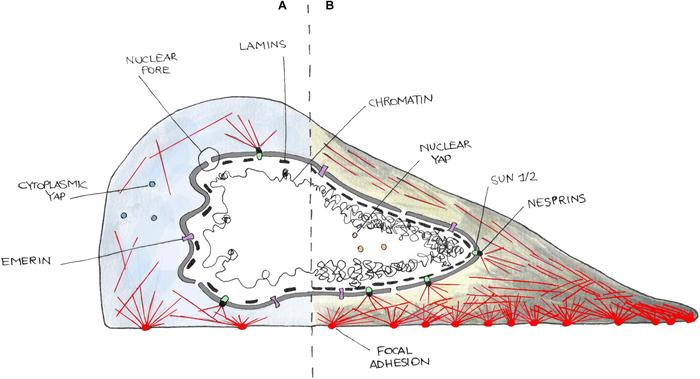
The nuclear structure and connections from Pennacchio FA, Nastały P, Poli A, Maiuri P. Tailoring cellular function: the contribution of the nucleus in mechanotransduction. Front Bioeng Biotechnol. 2021 Jan 8;8:596746
My research focuses on mechano-oncology, an interdisciplinary field that explores how physical and mechanical forces influence cancer development and progression. Beyond genetic changes, cancer cells are constantly exposed to physical stresses arising from their environment, and their ability to sense and adapt to these forces plays an important role in disease evolution.
A key aspect of my work is understanding how cancer cells respond to challenging conditions such as mechanical pressure, limited space, low oxygen levels, and other forms of cellular stress encountered during tumor growth and spread. These stresses can profoundly affect cell behavior, survival, and the ability to invade surrounding tissues or form metastases.
Central to this process is the cell nucleus, which safeguards genetic information and helps maintain cellular organization. Structural changes in and around the nucleus can influence how cells tolerate stress and adapt to hostile environments. By studying these processes at a general level, my research aims to uncover fundamental principles that govern cancer cell adaptation.
By integrating concepts from cell biology, biophysics, and oncology, my work seeks to contribute to a broader understanding of cancer as not only a genetic disease, but also a physical one. Ultimately, this perspective may support the development of improved diagnostic approaches and more precise, patient-oriented therapeutic strategies that take into account both biological and mechanical aspects of cancer.